Most walkers cover 10km in about 2 to 2.5 hours on flat, easy ground, assuming a steady pace of 4 to 5km per hour and not many stops. Add hills, rough paths, a lunch break or a slower companion and a 10km walk can easily become a four hour outing. The sensible way to plan is to start with a flat time, add time for ascent, then adjust for yourself.
That is the short answer. The longer answer is that estimating time is genuinely difficult, because it depends on so many things at once. Below you will find realistic times for 5km, 10km and 20km, how to account for climbing, and how to make the numbers fit your own legs rather than a textbook walker who never gets tired or stops for a photograph.
How fast does the average person walk?
A comfortable walking pace on level ground is usually somewhere between 4 and 5km per hour. Many people settle nearer 4km/h once they are carrying a rucksack, chatting, navigating or enjoying the view, whilst fitter walkers on good paths may manage a little over 5km/h. Younger children, heavy packs and uneven ground can all push you down towards 3km/h.
The 5km/h figure is the one used in Naismith’s Rule, the classic method hill walkers use to estimate time. It is a reasonable starting point, but for many people it is a touch optimistic across a whole day. If you have never timed yourself, assume 4km/h for planning and be pleasantly surprised if you beat it.
How long does it take to walk 5km, 10km or 20km on flat ground?
Here are the flat ground times at three different paces, with no allowance for stops:
- 5km: about 1 hour at 5km/h, 1 hour 15 minutes at 4km/h, or 1 hour 40 minutes at 3km/h.
- 10km: about 2 hours at 5km/h, 2 hours 30 minutes at 4km/h, or 3 hours 20 minutes at 3km/h.
- 20km: about 4 hours at 5km/h, 5 hours at 4km/h, or 6 hours 40 minutes at 3km/h.
These are moving times only. A sandwich stop, a few photographs, a gate that will not open and a quick look at the map all add up, so it is worth building in extra time rather than hoping it all averages out. A 20km walk in particular is a full day once you include breaks, and it is better planned as one than as a long morning.
How much time do hills add to a walk?
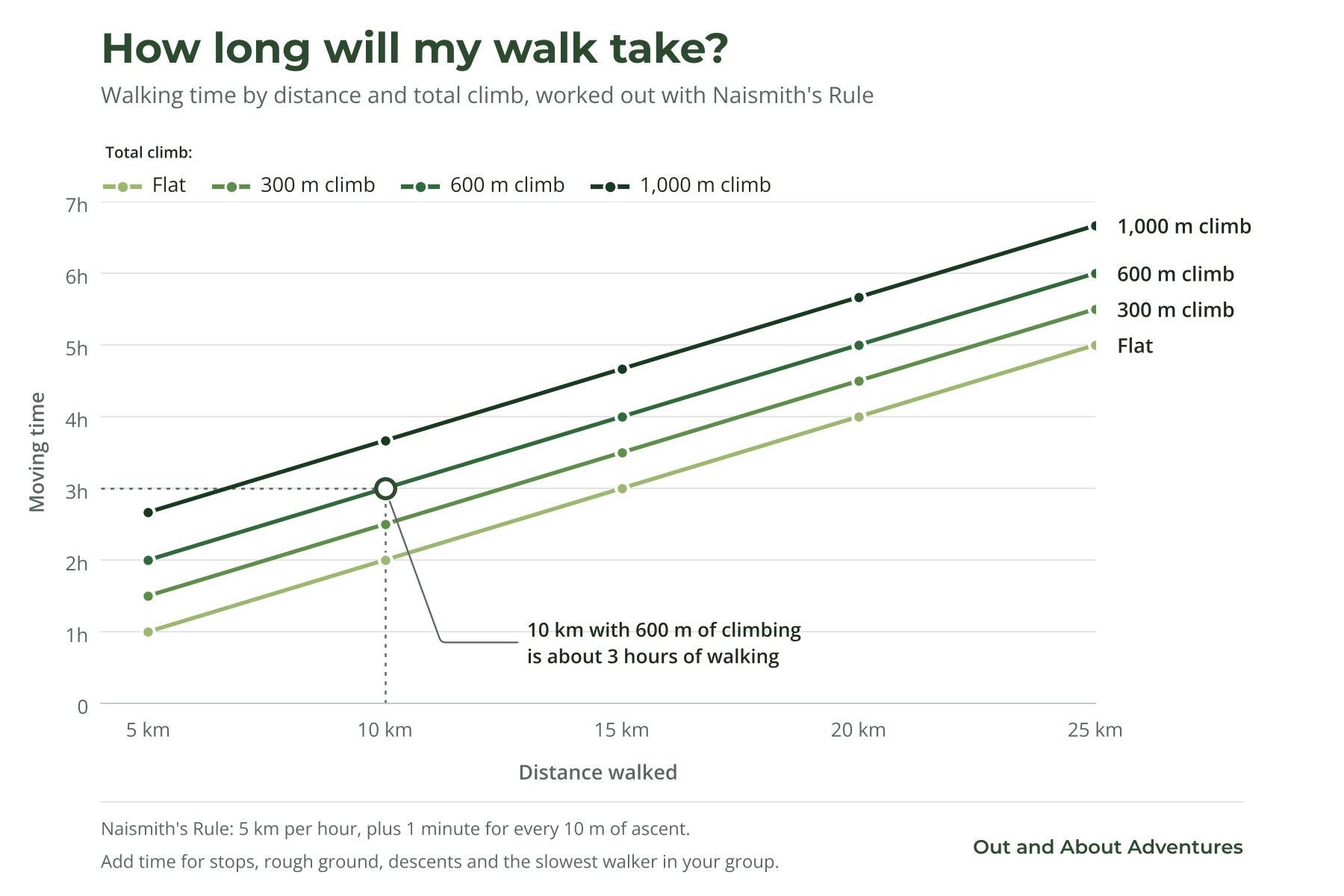
Quite a lot, and this is where flat-ground estimates fall apart. Naismith’s Rule adds one hour for every 600m of ascent on top of your time for the distance, which works out at roughly 10 minutes for every 100m you climb. It is a simple rule and a surprisingly useful one.
Using the 5km/h base, a few worked examples look like this. A 5km walk with 200m of climbing comes to about 1 hour 20 minutes. A 10km walk with 500m of climbing comes to about 2 hours 50 minutes. A 20km walk with 1,000m of climbing comes to about 5 hours 40 minutes, before any breaks. If your natural pace is nearer 4km/h, add the extra time for the distance first and then add the climbing on top.
Descents are not free either. Steep, rocky or wet ground can be slower going down than you would expect, and there are refinements to the rule for that. They are covered in Naismith’s Rule Explained: How to Accurately Plan Your Walking Time, and if you would rather not do the sums by hand, the Naismith walking time calculator does them for you.
How long does 950m, 2000 feet or 17km take to walk?
Search queries like these are common, and they usually come down to whether the number is a distance or a height. Here is how each works out.
950m as a distance is under a kilometre, so about 11 to 14 minutes at a normal walking pace. 950m as a climb is a very different thing: by Naismith’s Rule that is roughly 1 hour 35 minutes of ascent time, on top of the time for the horizontal distance. Always check which one you are dealing with before you plan your day around it.
2000 feet is about 610m. If that is the height you need to climb, Naismith gives you around an hour for the ascent alone, plus the time for the distance covered getting there.
17km on flat ground takes about 3 hours 25 minutes at 5km/h or around 4 hours 15 minutes at 4km/h. Add 10 minutes per 100m of ascent, plus your breaks, and you have a realistic estimate.
How do you work out your own walking pace?
This is the bit that matters most. A formula gives you a starting point, but the best estimate always comes from your own walking history. If you record your routes with a tracking app, you already have the data you need. Look back at walks you have finished, compare the distance and ascent with the actual time they took, and see how far you were from the calculator.
A simple way to do it:
- Pick three or four recent walks of different types, such as a flat riverside route, a rolling countryside walk and a proper hill day.
- Note the distance, the total ascent and your moving time for each.
- Put the same distance and ascent into the Naismith calculator and compare the result with what you actually did.
- Work out whether you are consistently faster or slower, and by roughly what percentage, then apply that adjustment to future plans.
You may find you are slower on rough mountain paths and faster on well-made tracks, or that your pace drops off sharply in the last third of a long day. Either is useful to know. Your fitness will change through the year too, so it is worth repeating the exercise now and then.

[AFFILIATE: GPS walking watch, accurate distance and ascent recording, long battery life, easy-to-read screen in bright light]
What else changes how long a walk takes?
Terrain is the big one. Boggy moorland, scree, stiles, deep mud and rocky ground all slow you down far more than the distance suggests. Weather matters as well: wind, rain, snow or ice will take your pace down, and poor visibility means more time spent navigating carefully. If you want to get comfortable with the map side of this, Learning Navigation Skills: The Essential Guide for Walkers is a good place to start.
If you are walking with other people, the pace of the group is the pace of the slowest member, not the fastest. Plan your timings around them from the start, and the day will be more enjoyable for everyone (including the fast one, who gets more time to eat their lunch).
On the hills, build in a margin and know your latest safe turnaround time, especially in winter when daylight is short. Check the Met Office mountain forecast or the Mountain Weather Information Service (MWIS) before you go, and carry the kit on The 10 Essentials Every UK Hiker Should Carry. If something does go wrong, call 999, ask for the Police, then ask for Mountain Rescue. You can also see what we recommend on the recommended gear page.
Frequently asked questions
How long does it take to walk 10km?
On flat ground, most people take between 2 hours and 2 hours 30 minutes to walk 10km, not counting stops. If the route includes climbing, add roughly 10 minutes for every 100m of ascent. Rough terrain and slower walkers in the group can stretch that to three hours or more.
Is 10km a long walk?
For most regular walkers, 10km is a good half-day outing rather than a long one. If you are new to walking, it is a sensible goal to build up to from 3 to 5km. On hilly ground it feels considerably longer than the number suggests, so judge it by time and ascent as well as distance.
How long does it take to walk 20km?
Allow 4 to 5 hours of moving time on flat ground, and more like 6 hours or longer with a good amount of climbing. Add breaks and it becomes a full day. It is best to set off early and plan a turnaround time, particularly on the hills.
How accurate is Naismith’s Rule?
It is a very good starting point but not a precise prediction. It assumes a fairly fit walker on reasonable ground, and it takes no account of weather, stops or the size of your group. The most accurate estimate comes from comparing the rule with your own recorded walks and adjusting for your pace.
How many miles is 10km?
10km is just over 6.2 miles. To convert quickly, multiply kilometres by 0.62. So 5km is about 3.1 miles and 20km is about 12.4 miles.
Leave a Reply